












Biodiversity
- Related ESG :
- E
- Policy and approach
- Identifying risks
- Initiatives for reducing environmental impact
- Initiatives for nature positive
- Engagement and collaboration with governments, non-profit organizations and local community
Policy and approach
Natural capital and the ecosystem services it provides form the foundation of human activities, with an estimated USD$44 trillion—equivalent to half of the global GDP—directly dependent on natural capital (WEF, The Future of Nature and Business, 2020). In recent years, the degradation of natural capital and loss of biodiversity have been increasingly recognized as socio-economic risks.
At the second part of the 15th meeting of the Conference of the Parties to the Convention on Biological Diversity (CBD-COP15), held in Canada in December 2022, the new global framework, the Kunming-Montreal Global Biodiversity Framework (GBF), was adopted. The GBF sets a 2050 vision of “a world living in harmony with nature” and establishes a 2030 mission to achieve nature-positive outcomes by halting and reversing biodiversity loss to put nature on a path to recovery.
In response, the Japanese Cabinet approved the National Biodiversity Strategy and Action Plan of Japan 2023-2030 in March 2023 to realize nature-positive outcomes domestically. Under its Sustainable Vision 2030, Toyobo Group identifies “quality water areas, air and soil, and preservation of biodiversity” as one of the social challenges to which it can contribute. Through products that reduce environmental impact and environmentally conscious manufacturing, the Group aims to mitigate negative impacts on biodiversity.
The TOYOBO Group Fundamental Policy on the Global Environment calls on the Group to actively support and participate in environmental protection and biodiversity conservation activities throughout society and in local regions, as a good corporate citizen. In doing this, we strive to minimize the impact of our business activities on ecosystems and contribute to a nature-positive society through conservation and protection initiatives in collaboration with local communities.
Action Guidelines for Biodiversity Conservation
We recognize that biodiversity is an essential part of a sustainable society. As a group which continues to create the solutions needed by people and the earth, understanding the impact of our business activities on conservation of biodiversity, we will endeavor to conserve the three types of biodiversity (species, genetic, and ecosystem diversity) through various activities.
- We will work to understand how the Group's business activities depend on and affect biodiversity, and endeavor to avoid or minimize negative impacts.
- We will strive to give consideration to biodiversity conservation throughout the entire value chain.
- We will contribute to the conservation by promoting development of Biodiversity-conscious products and technology.
- We will support and promote conservation activities through the employee's participation, and cooperation and collaboration with various stakeholders including local communities and NGOs.
- We will comply with domestic and overseas agreements on biodiversity.
Participation status of biodiversity conservation
We are promoting activities based on the "Action Guidelines for Biodiversity Conservation" with respecting "Declaration of Biodiversity, Guide to Action Policy" issued by Keidanren (Japan Business Federation), and "Guidelines for Private Sector Engagement in Biodiversity" formulated by the Ministry of the Environment, Japan.
| Period | Initiatives |
|---|---|
| Nov.2021 | Formulated the "Action Guidelines for Biodiversity Conservation." |
| Jan.2022 | Endorsed the "Initiative based on the Declaration of Biodiversity by Keidanren." |
| Nov.2022 | Participated in 30by30 Alliance for biodiversity. |
| First half of fiscal 2024 | “Toyobo Aya-no-Mori” forest was certified as a “Nationally Certified Sustainably Managed Natural Site” by the Ministry of the Environment, Japan |
| Aug.2024 | “Toyobo Aya-no-Mori” forest was listed in the World Database on Other Effective area-based Conservation Measures. |
Identifying risks
Toyobo Group's business activities and its involvement in biodiversity
For all of the Group's domestic and overseas production sites, we surveyed the 1 km area surrounding each site using the biodiversity assessment tool using IBAT*1 to determine proximity to protected areas, including World Natural Heritage Sites, IUCN*2 Protected Area Management Categories I-VI, the Ramsar Convention*3 wetlands, and KBAs*4. The sites located near such protected areas are listed in the table below.
Going forward, Toyobo Group will assess the dependence of its business activities on nature and biodiversity, as well as their impacts, and will implement biodiversity conservation activities that take into account the environmental characteristics of the regions where our sites are located.
- *1
- The abbreviation of "Integrated Biodiversity Assessment Tool" refers to a database of the world's protected areas in which the United Nations Environment Programme (UNEP) and other organizations participate.
- *2
- The abbreviation of "International Union for Conservation of Nature" refers to an international nature conservation network consisting of national, governmental and non-governmental agencies.
- *3
- Official name is "Convention on Wetlands of International Importance Especially as Waterfowl Habitat". It aims to conserve wetlands, which are an important habitat for a variety of organisms and a valuable resource for human life, through international cooperation and promote the wise use.
- *4
- KBA: Abbreviation for Key Biodiversity Area, referring to locations in terrestrial, freshwater, or marine ecosystems that host diverse natural environments and contribute to the survival of biodiversity.
Sites located near protected areas
| Site name | IBAT assessment result | Explanation |
|---|---|---|
| Toyobo Iwakuni Production Center Toyobo MC Iwakuni site TOYO CLOTH CO., LTD Iwakuni Plant (Iwakuni, Yamaguchi) |
Protected landscape areas Resource conservation areas |
Part of a national park or quasi-national park Areas to be protected for the sustainable use of natural resources |
| Toyobo Shogawa Plant (Imizu, Toyama) | Species and habitat management areas | Natural Habitat Conservation Areas, National Wildlife Protection Areas |
| Toyobo Inuyama Plant (Inuyama, Aichi) | Protected landscape areas Key biodiversity areas |
Part of a national park or quasi-national park Area critical for biodiversity conservation |
| Toyobo Odate Membrane Plant (Odate, Akita) | Species and habitat management areas | Natural Habitat Conservation Areas, National Wildlife Protection Areas |
| Toyobo Research Center (Otsu, Shiga) |
Species and habitat management areas Protected landscape areas Ramsar Convention wetlands Key biodiversity areas |
Natural Habitat Conservation Areas, National Wildlife Protection Areas Part of a national park or quasi-national park Wetlands of international importance Areas critical for biodiversity conservation |
| TOYO CLOTH CO., LTD Tarui Plant (Sennan, Osaka) | Resource conservation areas | Areas to be protected for the sustainable use of natural resources |
| MIYUKIKEORI CO., LTD. (Yokkaichi, Mie) | Species and habitat management areas | Natural Habitat Conservation Areas, National Wildlife Protection Areas |
| Toyobo Tsuruga Research and Production Center (Tsuruga, Fukui) * Toyobo MC Tsuruga site * Xenomax - Japan CO., LTD.*(Tsuruga City, Fukui) |
Species and habitat management areas Resource conservation areas Ramsar Convention wetlands |
Natural Habitat Conservation Areas, National Wildlife Protection Areas Areas to be protected for the sustainable use of natural resources Wetlands of international importance |
| Toyobo Takasago Plant* Toyobo MC Takasago Plant (Takasago, Hyogo)* |
Resource conservation areas | Areas to be protected for the sustainable use of natural resources |
| JAPAN EXLAN COMPANY., Ltd.*(Okayama, Okayama) | Resource conservation areas Key biodiversity areas |
Areas to be protected for the sustainable use of natural resources Areas critical for biodiversity conservation |
- Toyobo Tsuruga Research and Production Center, and Toyobo MC Takasago plant: Areas to be protected are located more than 1 km (but less than 2 km) from the site, but are included in the scope of this activity
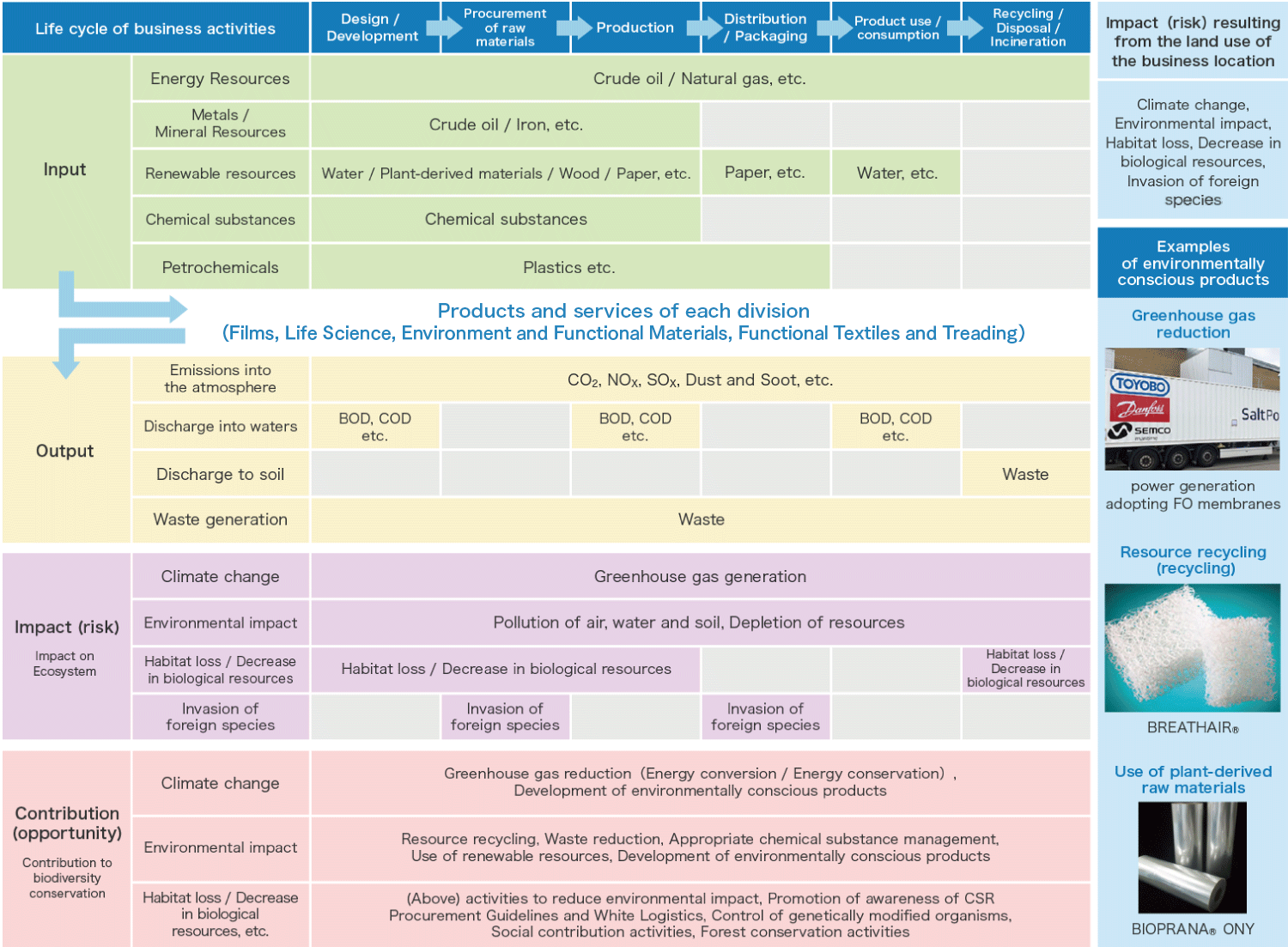
Relationship between business activities and biodiversity
Made with reference to the "Map of Relationships between Corporations and Biodiversity" published by the Japan Business Initiative for Biodiversity.
Initiatives for reducing environmental impact
To minimize the negative impact on biodiversity, we are proceeding following activities.
Reduction of environmentally hazardous substances emitted from production sites and plants
Under TOYOBO Group Fundamental Policy on the Global Environment, we have established voluntary standards for chemical substances discharged into the atmosphere and water that are stricter than those required by law, and we are working to thoroughly manage these substances and reduce their emissions.
Please see chemical substance management section for targets and achievements for fiscal 2031.
Environment impact assessment (Eco-Review System) at development
Since 1998, the Group has been using the Eco-Review System to evaluate the environmental impact and eco-friendliness of our products from the perspective of environment conservation. Under this system, we evaluate our products and technologies at every stage—from raw materials to disposal—based on their impact on climate change prevention, chemical substance reduction, resource conservation, waste minimization, contribution to the environment, and biodiversity.
Since this system is applied at every stage from R&D to commercialization, issues identified as needing improvement during the R&D stage are addressed by the next Eco-Review before commercialization. As a result, in developing products and technologies, we work to reduce environmental impact and enhance features that contribute to biodiversity conservation and other environmental benefits.
Implementation of cleanup activities to preserve the biodiversity of the Seto Inland Sea
The Seto Inland Sea is one of the most important areas for biodiversity conservation. Our business sites and Group companies (Iwakuni Production Center, Toyobo MC Takasago Plant, Toyo Cloth Co., Ltd., Japan Exlan Co., Ltd., Toyobo Photo Chemicals Co., Ltd.) are located in this surrounding area. These business sites, and companies conduct cleanup activities at least once a year to pick up litter along the coast and in rivers flowing into the Seto Inland Sea.
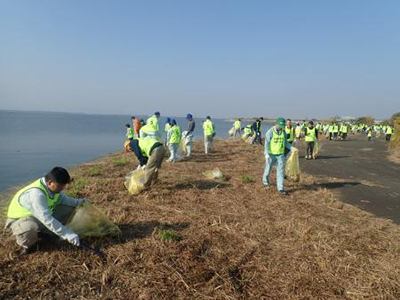
Cleanup activity near Iwakuni Production Center
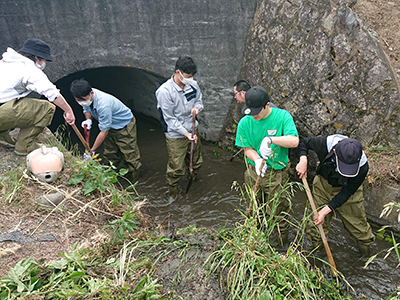
Cleanup activity at Japan Exlan Co., Ltd.
We are also expanding our activity areas to areas outside the Seto Inland Sea, and are working as a group to conserve habitats.
Initiatives for nature positive
Research Center
Biodiversity conservation initiatives at Research Center
The Research Center is located adjacent to Lake Biwa, which is a "species and habitat management area" based on IBAT's risk assessment. We are grateful for our location, which is blessed with remaining biodiversity not only in Lake Biwa but also in the rivers and satoyama landscape, and are committed to conservation activities aimed at creating an environment where people and living things can coexist in harmony.
Conducting biological surveys
In fiscal 2024, we conducted a survey of plants, insects, birds, amphibians, reptiles, mammals, and aquatic organisms at the Research Center. As a result, about 600 species of organisms were found, including about 500 native species, 100 non-native species, and 20 species listed in the Red Data Book. The survey revealed that the Research Center is a "buffer zone between people and Lake Biwa" with remnants and connections to Lake Biwa, as there are lakeside forests such as willow and hackberry, reed beds growing in the adjustment pond, and dragonflies and aquatic species that breed in Lake Biwa. The survey debriefing session held in March 2024 was attended by about 100 people, including online participants, who were able to once again experience the rich nature of the Research Center, leading to an increased awareness of biodiversity conservation.
Based on the survey results, we have started removing specific invasive alien species within our Research Center during the annual lakeside cleanup activities. Going forward, we will continue planning conservation activities suited to the local environment.
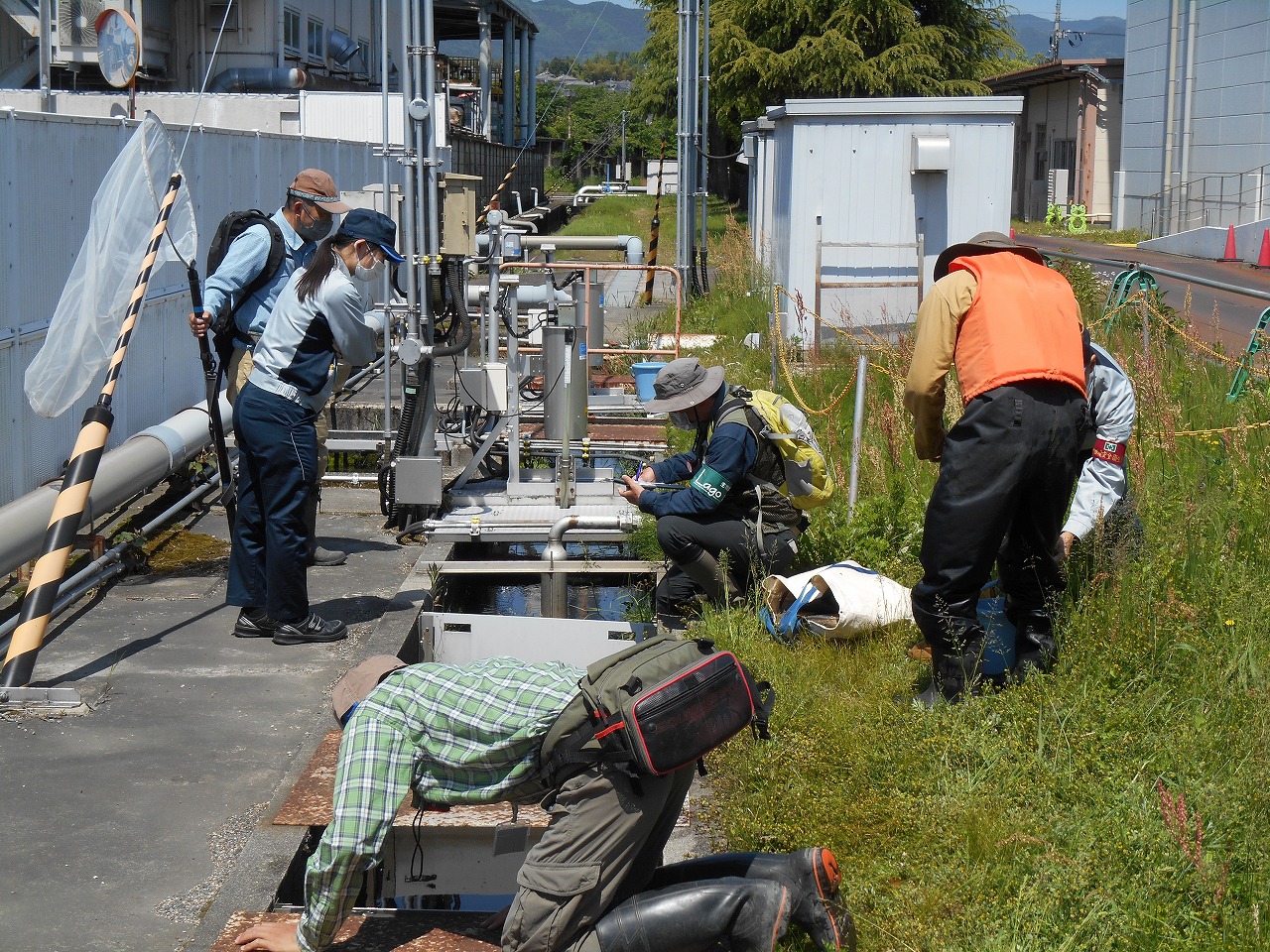
Biological surveys at Research Center
Lake Biwa shoreline cleanup activities
Every year, we conduct cleanup activities in the Research Center and neighboring areas, with particular emphasis on picking up trash and removing weeds along the shores of Lake Biwa. Based on the results of the biological survey, in fiscal 2025, we also started extermination of designed invasive alien species in the Research Center. On the day of the activity, a total of 524 employees including those from partner companies participated. These activities are linked to raising employee awareness and contributing to the local community through beautification of the surrounding area. We will continue our efforts to preserve the rich ecosystem.
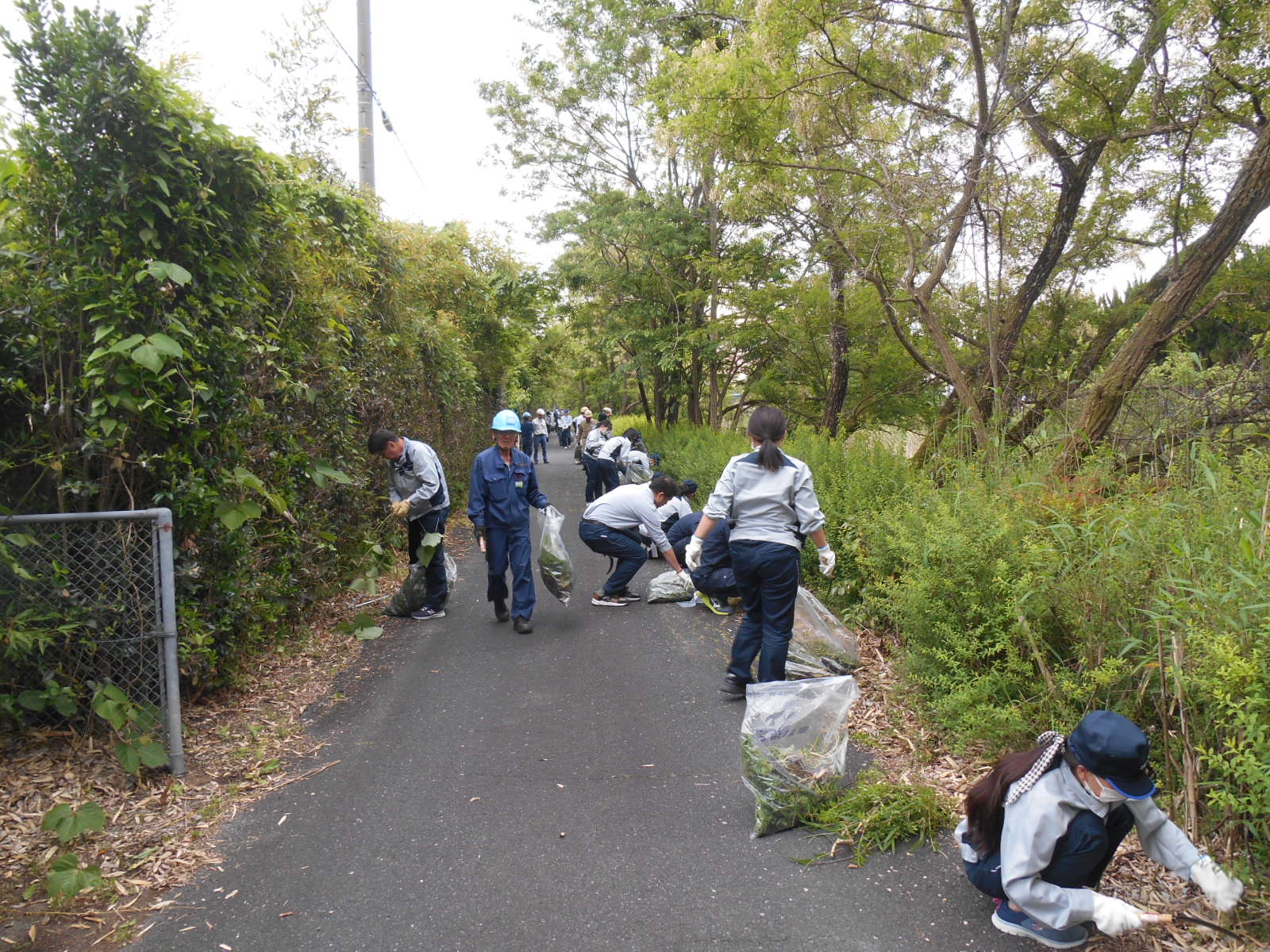
Scene from a cleanup activity
TOYOBO Forest in AYA
We had purchased forests since the 1950s to ensure domestic self-sufficiency of chemical fiber raw materials. Subsequently, due to changes in the composition of the chemical fiber business, the forests ceased to be a source of raw materials and we now hold only a portion of the forests for timber production.
We promote forestry activities while maintaining its function as a water source conservation forest. We will also promote sustainable forest management with the aim of coexistence between people and nature by placing emphasis on continuity with the abundant forests surrounding us.
Biodiversity conservation initiatives at “TOYOBO Forest in AYA”
In fiscal 2023, we began a monitoring survey of company-owned forests located in Aya Town, Miyazaki Prefecture. Through surveys, we confirmed the existence of rare organisms (e.g., domestic rare wild fauna and flora species, Ministry of the Environment Red List 2020: endangered IB species, and Miyazaki Prefectural Red List 2022: endangered I species) exist and feeding damages caused by deer and other predators. Regarding animal pollution, we have already implemented measures such as installing a deer fence in the afforestation area, but this is the first time we have conducted a survey of the entire forest.
In the future, we will continue monitoring surveys and consider new activities in collaboration with local communities and recovery from animal damage.
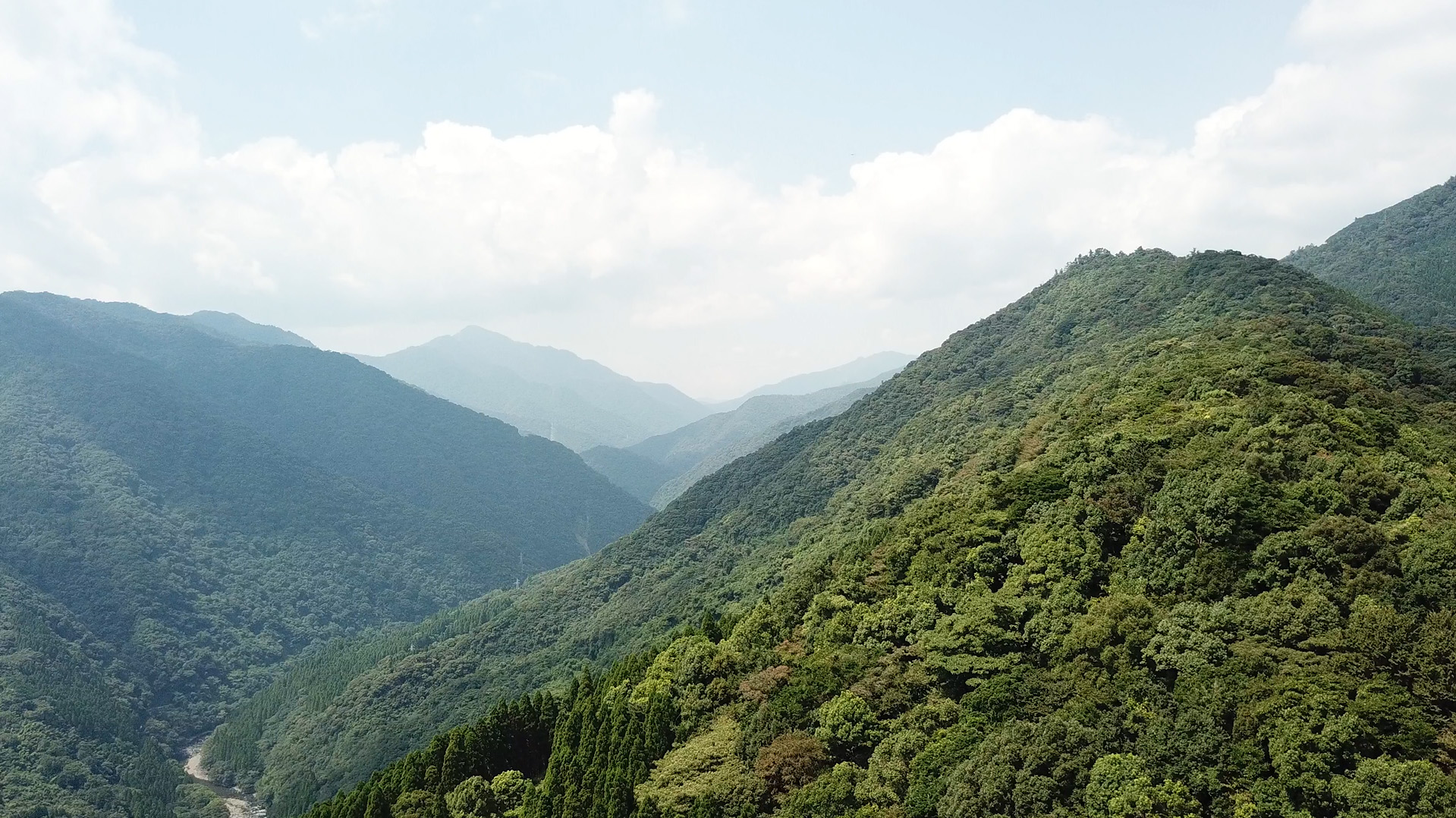
“Toyobo Aya-no-Mori,” a forest in Aya-cho, Miyazaki Prefecture
Participation in biodiversity certification programs
The Ministry of the Environment, Japan, began in fiscal 2024 certifying areas where biodiversity conservation is promoted through private-sector initiatives (OECMs*) as Nationally Certified Sustainably Managed Natural Sites.
In the first half of fiscal 2024, the "Toyobo Aya-no-Mori" forest was certified as "Nationally Certified Sustainably Managed Natural Sites" in recognition of the Group's efforts to conserve biodiversity in the forest.
Subsequently, in August 2024, the forest was listed in the World Database on Other Effective Area-Based Conservation Measures (WD-OECM). This will contribute to achieving the ”30by30” goal, an international target to conserve at least 30% of the Earth's land and oceans by 2030.
Calculation of CO2 absorption
The amount of CO2 absorbed in our company-owned forests is currently estimated to be approximately 6 thousand tonnes/year for a forest area of 1500 ha.
Contributing through business processes and products
Environment and fiber business
We are also contributing to reduce impact on the environment of our customers through the markets of waste fluids, drain, and exhaust gas treatment equipment, as well as water treatment membranes.
Engagement and collaboration with governments, non-profit organizations and local community
Environmental education activities
The Group conducts environmental seminars as part of its environmental education program. In June 2023, as part of biodiversity conservation activities of Toyobo Research Center, (Otsu City, Shiga Prefecture) we invited a professor from Biodiversity Science Research Centre, Ryukoku University (Otsu City) to give a lecture on biodiversity conservation and its significance: environment DNA analysis as an observation technology.
A total of about 200 participants studied cutting-edge science studies on biodiversity conservation, with Toyobo Research Center as their primary venue and company-wide online.
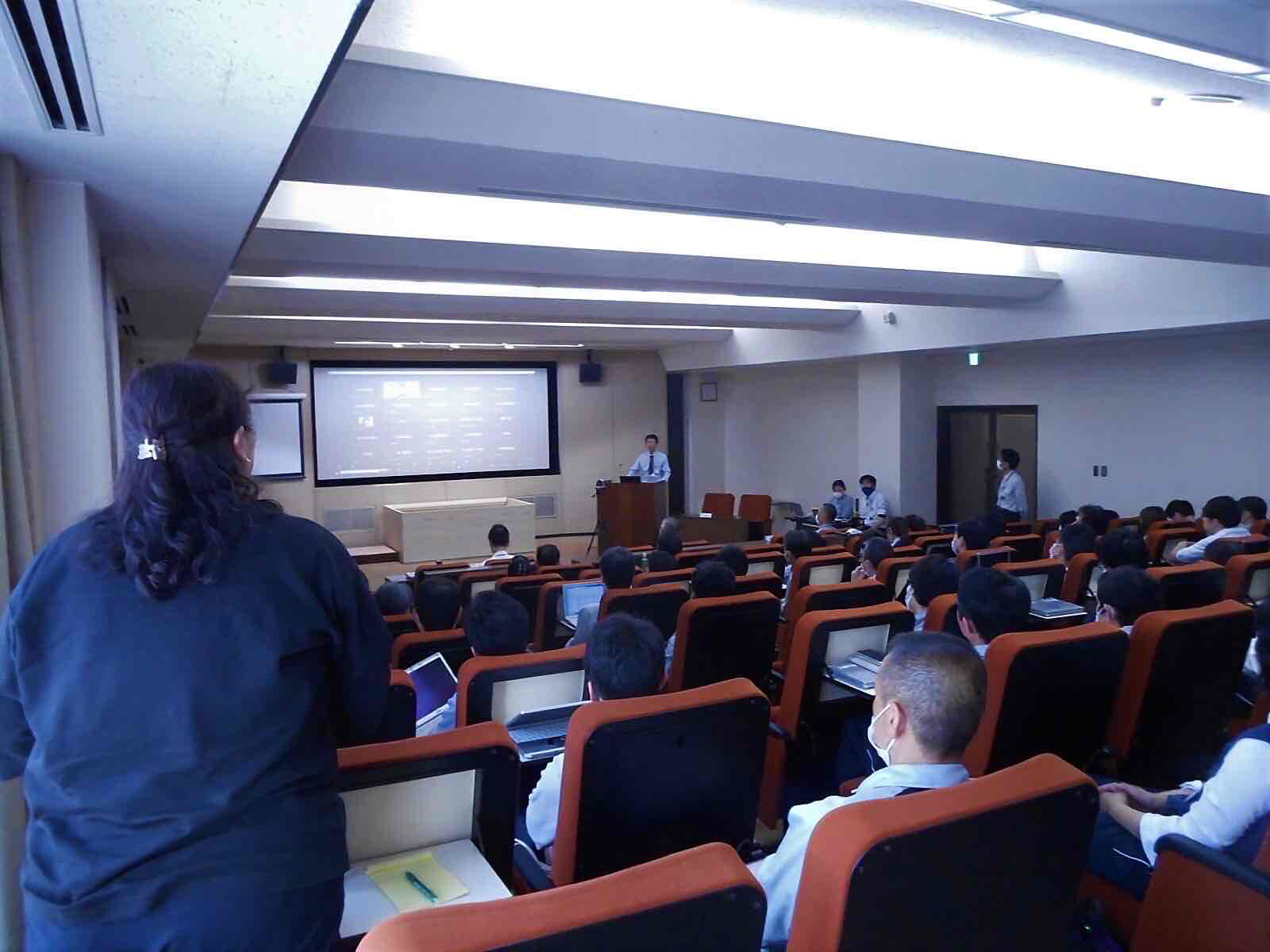
Scenes of environmental seminars in FY2024
Cooperative management of groundwater (Tsuruga Research and Production Center)
Tsuruga Research and Production Center of our Group participates in the ”Tsuruga City Water Environment Improvement Roundtable”, which consists of local government officials, academics, residents, companies, and NGOs that have come together for the purpose of groundwater management. The report provides information on measures to achieve the reduction targets promised to the local government and citizens, as well as the results of activities and future plans.
Toyobo Group will continue to work with local communities to properly manage groundwater use in order to conserve biodiversity.
Lake Biwa day event: 100 sites eDNA survey (Research Center)
Toyobo Group has supported "Lake Biwa Challenge: 100 sites eDNA survey," a project to research living organisms in Lake Biwa, Japan's largest lake in Shiga Prefecture. The survey, conducted by Ryukoku University's Center for Biodiversity Science, is a sub-project of “Ryukoku Lecture with Shiga Prefecture related to Lake Biwa Day,” an open lecture of Ryukoku University. In this survey, local citizens, organizations, and companies collect water samples at 100 locations around the lake each year. The samples are analyzed for environmental DNA* to provide data essential for biodiversity conservation, such as habitat distribution and the spread of invasive species.
The Research Center has participated in local environmental activities and launched its own campaigns to clean up the lake with the aim of conserving the lake's biodiversity. Furthermore, we have been participating in the survey since fiscal 2023. We will continue to collect water on a regular basis for the future and contribute to the survey of Lake Biwa.
- DNA expelled by living organisms, such as those originating in their body fluids and feces.
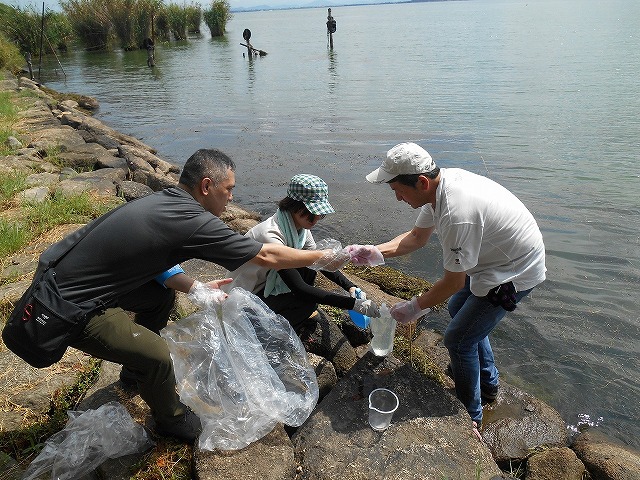
Water sampling
Participation in local environmental citizen surveys (Research Center)
At our Research Center, we strive to enhance environmental education and engage in dialogue with local communities in line with our environmental policy.
In Otsu City, where the Research Center is located, a local environmental citizen survey is conducted annually to raise citizens’ environmental awareness and compile environmental information. Since fiscal 2020, Toyobo has participated in this survey as the Research Center. Employees and their families who wish to participate observe designated species and record their findings, including species types and locations, on survey forms submitted to Otsu City.
Participants reported that the survey provided an opportunity to observe local nature and that they were pleasantly surprised by the diversity of species, such as acorns and swallows. Going forward, we will continue to promote awareness of nature conservation through participation in such activities.
Promotion of greening at Shikinomori (Japan Exlan Co., Ltd.)
At the Saidaiji Plant of Japan Exlan Co., Ltd., the former company housing site has been developed into the green space park Shikinomori for over 30 years, actively promoting greening efforts. The park features approximately 30 species of trees and is home to wildlife such as cicadas, dragonflies, and rhinoceros beetles. The park is open to the local community and is enjoyed as a place of relaxation, with nearby residents using it as a walking route. It also serves as a space for community engagement, including hosting school field trips.
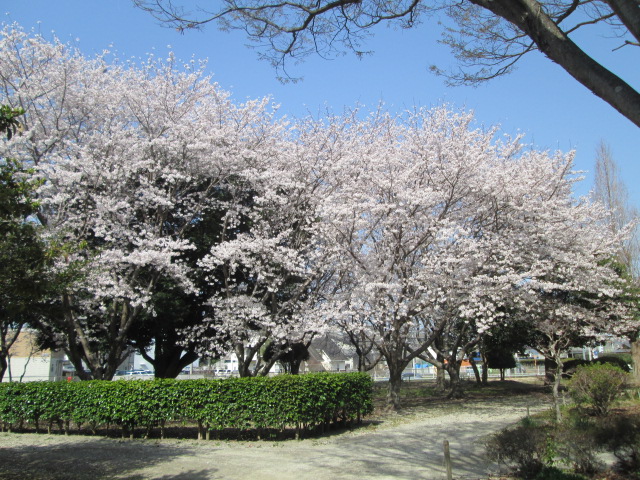
Shikinomori
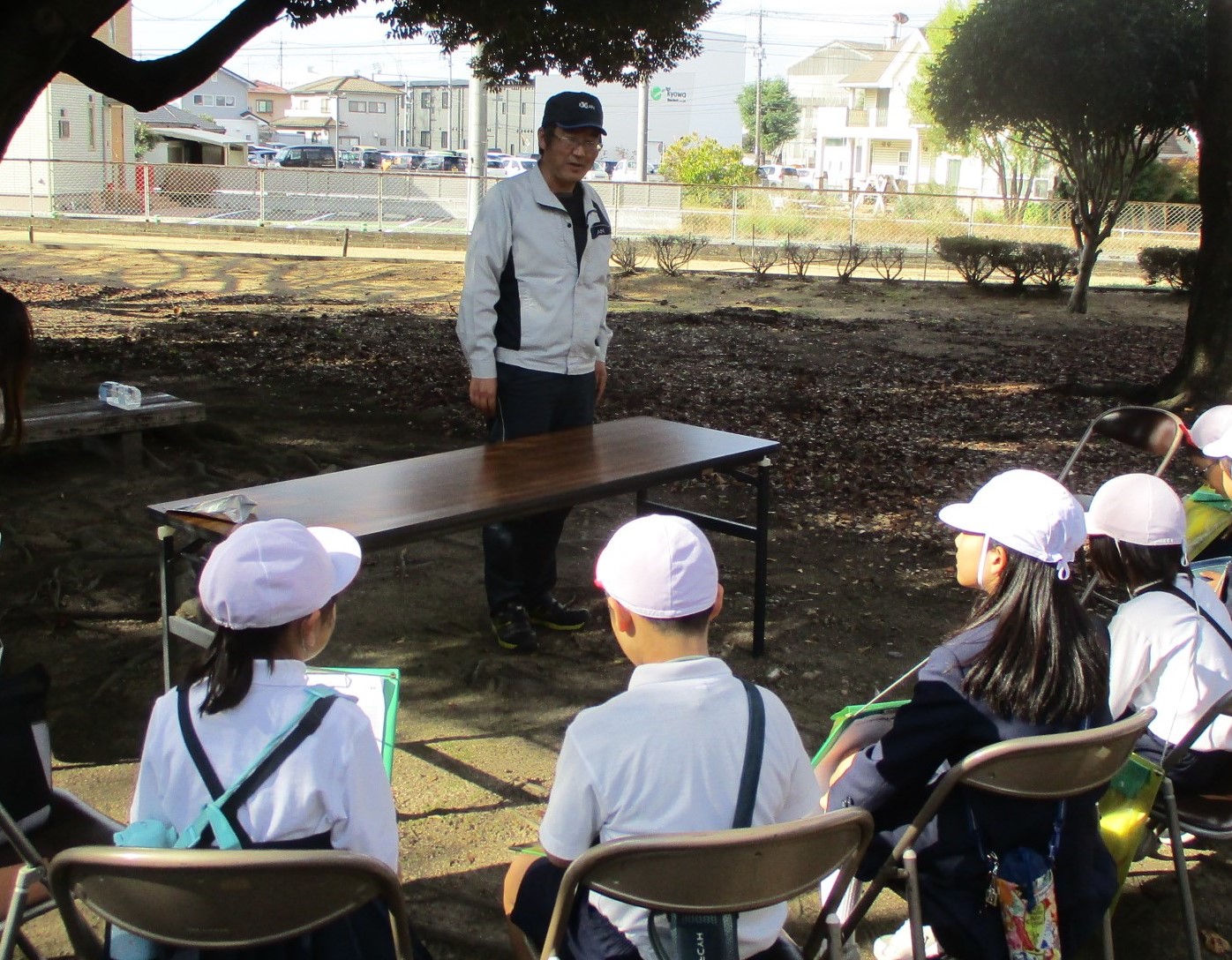
Scene from a school field trip
Forest conservation activities at "Toyobo Future Forest" in Wakayama prefecture
We have worked on Forest Conservation Activities of "Toyobo Future Forest" in a mountain forest in central Wakayama prefecture. Since its inception in 2006, in cooperation with the local Hidaka town and the forest association of Kichuu (or central Wakayama prefecture), we have been working on tree planting and weeding, etc. In November 2021, we supplementally planted broadleaf trees such as wild cherry, sawtooth oak, and maple.
Wild deer live in this area of the forest and sometimes eat the seedlings of the trees. For the coexistence of deer and trees, the area around the "Future Forest" is enclosed with nets which use our material, IZANAS® to prevent animals from entering. We also installed deer protection covers on the seedlings.
Through forest conservation activities in Wakayama prefecture, we will contribute to issues such as biodiversity and climate change.
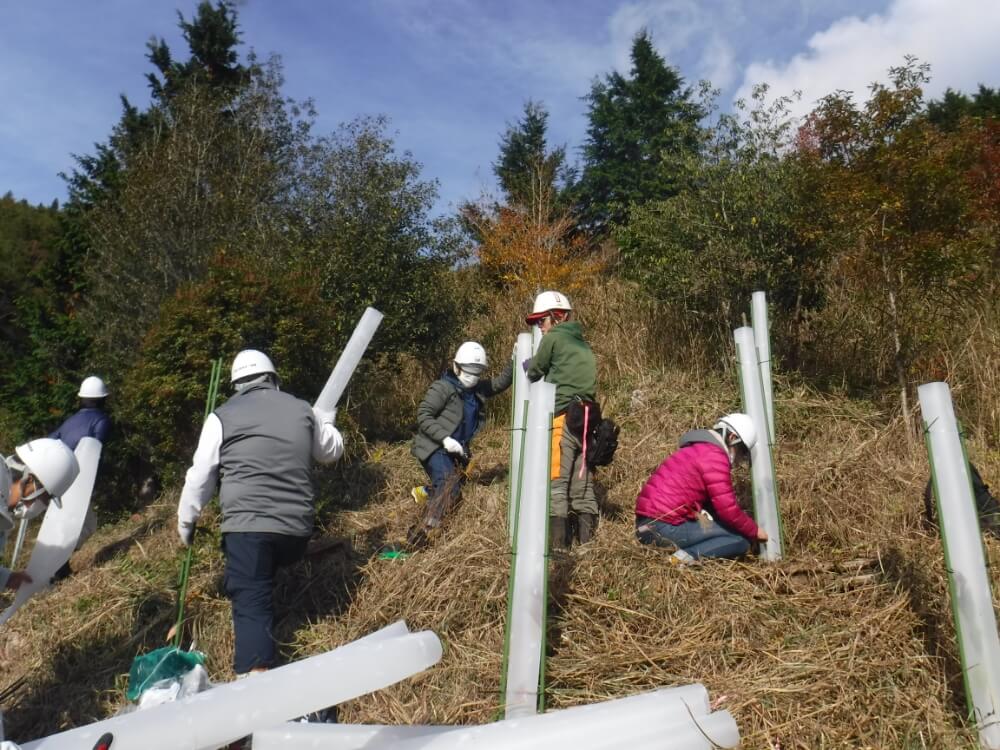
Putting covers preventing feeding damage by deer on saplings
Join the 30by30 alliance
In November 2022, TOYOBO and Toyobo Real Estate Co., Ltd. joined 30by30 alliance for biodiversity to promote activities aimed at halting and restoring biodiversity losses.
Comprehensive partnership agreement with the town of Aya, Miyazaki Prefecture (TOYOBO Forest in AYA)
In June 2023, we concluded a comprehensive collaboration agreement with Aya town, Miyazaki Prefecture, where one of our Group-owned forests is located.
Aya town has one of the largest laurel forests in Japan, and has been registered as a UNESCO Eco Park by UNESCO (United Nations Educational, Science and Cultural Organization) in 2012, receiving high praise worldwide for its efforts to create a community that coexists with nature.
In the future, we will work together to revitalize the Aya town area using our company-owned forests and to coexist with our sustainable manufacturing and conservation of the natural environment.