









Promotion of Women's Participation and Advancement
Progress so far, and the key issues
Promoting women's participation and advancement from the three perspectives of recruitment, cultivation, and support for employment continuation
As of 2015, our Group was predominantly male-dominated and did not provide adequate opportunities for women to thrive and grow. However, the Group began full-scale efforts to promote women's participation and advancement in the workplace with the establishment of the Women Empowerment Promotion Group in 2015.
Under our Phase 1 Action Plan, spanning fiscal 2017 to fiscal 2021, we set goals to double the number of women in managerial positions compared to fiscal 2016 and to raise the ratio of women in career-track positions*1 to 15%. We implemented a range of initiatives focused on three key areas: recruitment, development, and support for continued employment. As a result, by the end of fiscal 2021, we had tripled the number of women in managerial roles to 13 and increased the ratio of women in career-track positions to 17.1%, thereby achieving our targets.
For our Phase 2 Action Plan (April 1, 2021 - March 31, 2026), we set new goals: to raise the proportion of women in managerial positions to at least 5% and the ratio of women in career-track roles to at least 22%. We also set targets for at least 80% of eligible male employees to take childcare leave and to increase the average number of days taken for parental leave by 20% compared to fiscal 2021. We have already exceeded both the women-in-management target and the target for eligible male employees taking childcare leave ahead of schedule.
Under the Phase 3 Action Plan, we have set targets of increasing the ratio of female employees in management positions to at least 6.5% and the ratio of female employees on the managerial career track to at least 22% by the end of fiscal 2031, and we will continue our efforts to achieve these goals.
Since 2015, our steady and continuous efforts to promote the advancement of women have led to consistent improvements in the ratio of female employees in management positions and the childcare leave uptake rate among eligible male employees. These efforts have also contributed to the development of systems that support diverse work styles and to positive changes in our corporate culture.
In 2023, we changed the name of the department to the Diversity Promotion Group. In addition to promoting the advancement of women, the Group works to establish a workplace foundation where employees with disabilities, non-Japanese employees, sexual minorities, and all other employees can work with peace of mind.
Beginning in 2026, the department was renamed the Labor Relations and Diversity Promotion Group, enabling it to respond more quickly to matters such as revisions to laws and regulations.
We will continue our efforts to support the active participation of female employees. Looking ahead, however, our challenge is to create an environment in which opportunities and responsibilities are assigned fairly regardless of gender and where positive action measures are no longer necessary. To achieve this, we believe it is important to continue initiatives that promote the advancement of women while further raising employee awareness and understanding of diversity.
- *1
- Defined as employees at or above the entry-level grade of the global career track.
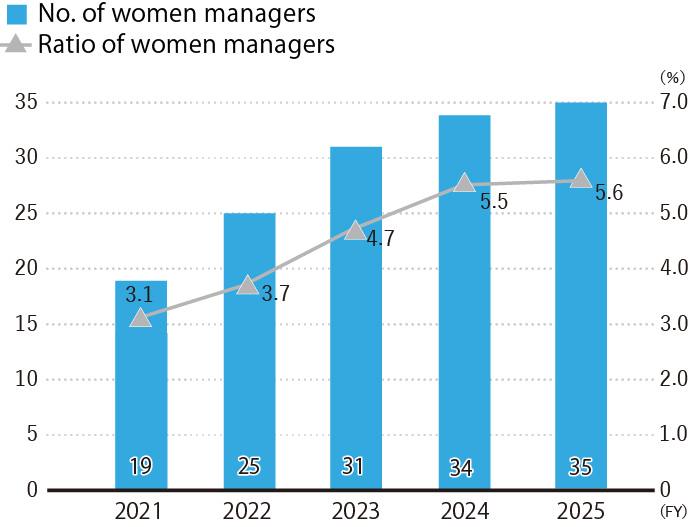
Ratio of female employees in management positions
Main measures implemented
- Women leader development seminars
- Mentoring system
- Encouraging childcare leave uptake through notifications to eligible employees and their supervisors, as well as pre- and post-childcare leave interviews
- Babysitter support system, including partial coverage of childcare costs during business trips
- Establishment of an on-site nursery at the Research Center, with a capacity for 10 children
- Introduction of maternity workwear for pregnant employees at business sites
Actions taken and results against targets
In April 2021, we launched the Phase 2 Action Plan. As numerical targets for fiscal 2026, we set goals including raising the ratio of female employees in management positions*2 to 5.0% or higher. As a result of our ongoing efforts, the ratio of female employees in management positions reached 5.6% as of the end of fiscal 2026. The ratio of female employees among newly hired graduates in the Global Career Track was 31.8%, compared with the target of 40%.
Under the Phase 3 Action Plan, which began in fiscal 2027, we have set targets of increasing the ratio of female employees in management positions to at least 6.5% and the ratio of female employees on the managerial career track to at least 22% by the end of fiscal 2031, and we will continue our efforts to achieve these goals.
We also intend to actively participate in external initiatives. We have already endorsed the objectives of the “Challenge to 30% by 2030”*3 promoted by the Japan Business Federation (Keidanren) and the Women's Empowerment Principles (WEPs)*4, which set out principles for companies committed to advancing women's empowerment. We have signed a statement committing to act in accordance with these principles.
Targets and initiative content
| 【Target No.1】Raise the share of managers who are women to at least 5% by the end of fiscal 2026 | |
|---|---|
| April 2021 onwards: |
Provide leadership development training for women managers and candidates for managerial positions (continued implementation since August 2017) |
| April 2021 onwards: |
women managers and candidates for managerial positions (continued implementation since September 2019) |
| April 2021 onwards: | Implement mid-career hiring of women managers |
| May 2022 onwards: | Launch diversity & inclusion training seminars for managers Aim to enhance communication with diverse employees |
As of the end of fiscal 2026, the ratio of female employees in management positions reached 5.6%.
| 【Target No.2】Raise the share of women on the career track to at least 22% by the end of fiscal 2026 | |
|---|---|
| April 2021 onwards: | Maintain women's share of new graduate recruitment at a level of at least 40% |
| April 2021 onwards: | Actively promote mid-career hiring of women employees |
| April 2021 onwards: | Implement follow-up interviews for women employees (continued implementation since April 2015) |
| April 2021 onwards: | Establishment and operation of a three-year career development support program |
As of the end of fiscal 2026, the ratio of female employees on the managerial career track was 21.2%.
| 【Target No.3】Raise the percentage of eligible male employees taking childcare leave to at least 80%, and increase the number of days of childcare leave taken by at least 20% by the end of fiscal 2026 | |
|---|---|
| April 2021 onwards: | Make eligible employees aware of the childcare leave system (continued implementation since April 2019) |
| April 2021 onwards: | Send eligible employees' supervisors details of the encouragement that should be provided to subordinates to encourage them to take childcare leave (continued implementation since September 2019) |
| October 2022 onwards: | Making pre- and post-childcare leave interviews between employees and their supervisors mandatory to support the smooth taking of childcare leave and return to work |
As of the end of fiscal 2026, the childcare leave uptake rate among eligible male employees was 116.2%, and the average number of days of childcare leave taken in fiscal 2026 was 35.7 days (compared with 9 days in fiscal 2022).
- *2
- Manager-level positions and above
- *3
- This is one of the targets for promoting D&I to realize sustainable growth in line with “The NEW Growth Strategy” announced by the Keidanren in November 2020.
- *4
- The Women's Empowerment Principles were formulated jointly by UNGC and UN Women in 2010.